
Your Guide to Preparing for the ACC Exam
Last Updated : November 20th, 2026
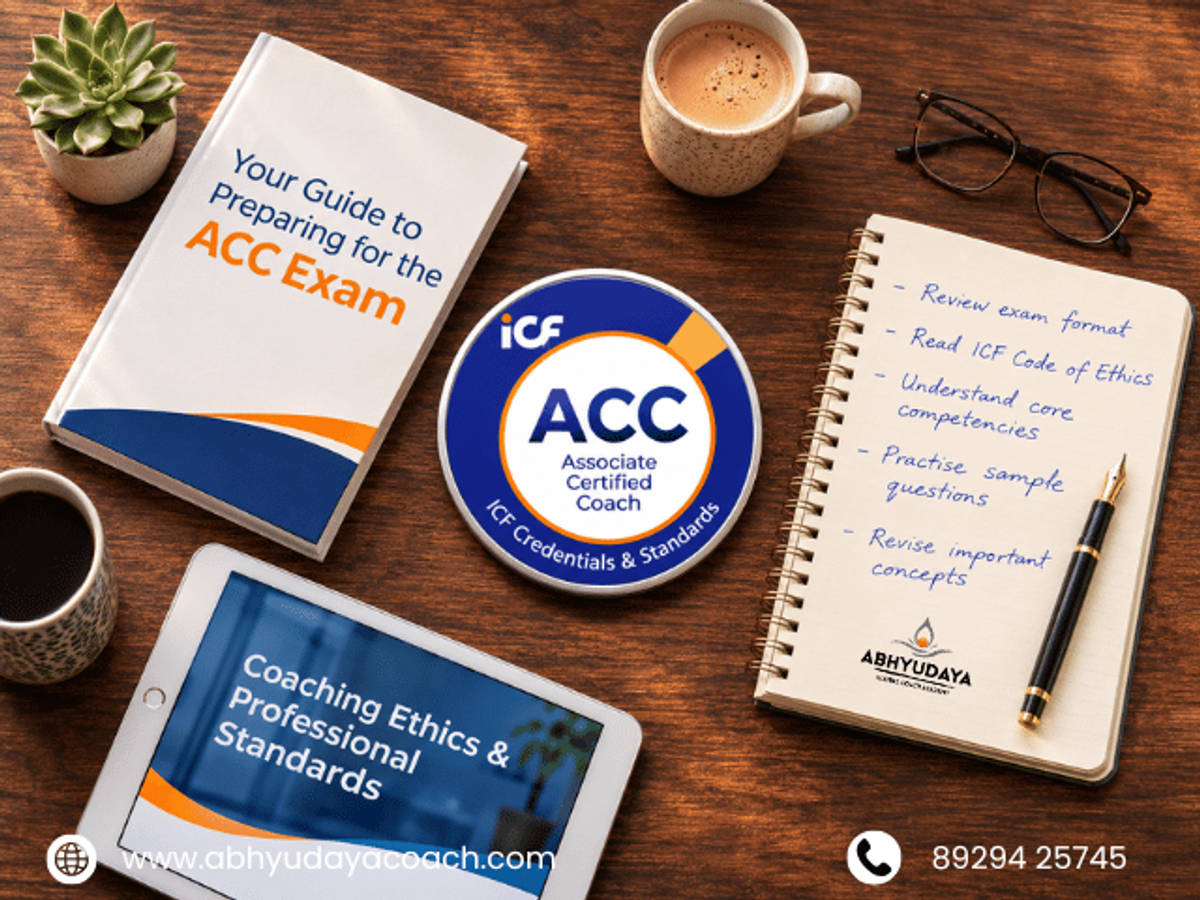
Prepare for the ICF ACC Exam with this practical guide covering the exam format, scoring system, key coaching competencies, ethics, and preparation tips. Learn what to expect and how ICF Level 1 coach training can help you build a strong foundation for your ACC credentialing journey.
Planning to become an ICF Associate Certified Coach (ACC)? One of the important steps in your credentialing journey is preparing for the ICF ACC Exam.
For aspiring coaches, the examination is an opportunity to demonstrate their understanding of professional coaching, ethical responsibilities, coaching competencies, and the principles that guide effective coaching relationships.
However, knowing what to study is only one part of preparation. Understanding the exam format, question types, scoring system, and key knowledge areas can help you prepare with greater confidence.
Whether you are completing your ICF Level 1 Coaching Certification programme, exploring ICF coach training in India, or preparing to apply for your ACC credential, this guide will help you understand what to expect and how to approach your preparation.
Key Takeaways
The ICF ACC Exam consists of 60 multiple-choice, knowledge-based questions.
Candidates have 90 minutes to complete the examination, including an optional 10-minute break.
The examination covers Coaching Ethics, Definition and Boundaries of Coaching, and Coaching Competencies, Strategies and Techniques.
A scaled score of 460 out of 600 is required to pass.
Understanding the ICF Core Competencies and Code of Ethics is essential for preparation.
Completing an eligible ICF Level 1 coaching education programme provides an education pathway towards the ACC credential, subject to meeting other ICF requirements.
Reviewing coaching concepts, practising sample questions, and revisiting your coach education materials can strengthen your readiness.
What Is the ICF ACC Exam?
The Associate Certified Coach (ACC) credential is an entry-level professional credential offered by the International Coaching Federation (ICF).
It recognises coaches who have developed foundational coaching knowledge and demonstrated their understanding of professional coaching standards.
The ICF ACC Exam is designed to assess your knowledge of coaching principles, ethical practices, professional boundaries, and the competencies required to establish effective coaching relationships.
Unlike a traditional academic examination that focuses on memorising information, the ACC Exam evaluates your understanding of coaching as a professional practice.
You are expected to understand the role of a coach, recognise ethical responsibilities, and identify the principles that support client-centred coaching.
For individuals pursuing ICF Level 1 Coaching Certification, understanding the ACC examination is particularly useful because it connects foundational coach education with the knowledge required for professional credentialing.
Preparing for this examination is therefore an important opportunity to strengthen your foundation as a professional coach.
Understanding the ICF ACC Exam Format
Before beginning your preparation, it is useful to understand how the examination is structured.
The ACC Exam is a computer-based examination that can be taken at an approved Pearson VUE testing centre or through its online OnVUE remote-proctored testing service.
Here are the important examination details:
How Is the ACC Exam Divided?
The examination is divided into two sections, with an optional scheduled break between them.
Section 1:
Examination instructions: 2 minutes.
First section: 30 questions.
Time allowed: 39 minutes.
Optional Break:
Scheduled break: 10 minutes.
Section 2:
Second section: 30 questions.
Time allowed: 39 minutes.
Candidates can flag questions for review within the applicable examination section, provided there is sufficient time remaining.
It is also important to know that the ACC Exam includes 10 unscored field-test questions. These are mixed with the scored questions and are used by ICF to evaluate potential examination items.
What Types of Questions Are Asked in the ICF ACC Exam?
The ICF ACC Exam uses knowledge-based questions. Each question presents four possible answers, with only one correct response.
These questions assess your understanding of coaching concepts, professional standards, and the principles that guide coaching practice.
Here is an example to help you understand the question format.
Knowledge-Based Question
Which ICF Core Competency focuses on helping clients develop awareness through meaningful questions, reflection, and exploration?
Establishes and Maintains Agreements
Cultivates Trust and Safety
Evokes Awareness
Facilitates Client Growth
Correct Response: 3. Evokes Awareness
Knowledge-based questions have only one correct answer. They are designed to assess your knowledge and understanding of coaching facts, concepts, competencies, and professional standards.
How Are Knowledge-Based Questions Different from Situational Judgment Questions?
It is important to understand that the ACC Exam and the PCC/MCC Credentialing Exam have different question formats.
The ACC Exam focuses on knowledge-based questions, whereas the updated PCC-MCC Exam includes both knowledge-based and situational judgment questions.
Knowledge-based questions assess your understanding of coaching principles and professional concepts.
Situational judgment questions present realistic professional situations and assess how you would respond as a coach.
Here is an illustrative example of a situational judgment question to help explain the difference. This is an independently created example and does not represent actual ICF examination content.
Situational Judgment Question
During a coaching session, your client shares that they are struggling to make an important career decision. They repeatedly ask you to tell them which option would be best for their future.
How should you respond as a professional coach?
Share your personal experience and recommend the option you believe is best.
Explain the advantages and disadvantages of each option and make a decision for the client.
Ask open-ended questions to help the client explore their priorities, values, and possible choices.
Suggest that the client postpone the decision until they feel more confident.
Best Response: 3. Ask open-ended questions to help the client explore their priorities, values, and possible choices.
Rationale: Coaching supports client autonomy and self-discovery. Instead of making decisions on behalf of the client, a coach creates an environment where clients can explore their thoughts, identify possibilities, and develop their own solutions.
Understanding these differences helps you recognise the type of knowledge and professional judgement expected at different stages of the ICF credentialing journey.
What Are the Main Topics Covered in the ICF ACC Exam?
The ACC examination assesses three major areas of coaching knowledge. Understanding their weightage can help you organise your preparation.
1. Coaching Ethics – 30%
Professional ethics are fundamental to building trust and maintaining the integrity of a coaching relationship.
This section evaluates your understanding of the ethical responsibilities of a professional coach and how to maintain appropriate standards while working with clients.
Important topics include:
Understanding the ICF Code of Ethics.
Maintaining confidentiality and privacy.
Recognising conflicts of interest.
Establishing clear coaching agreements.
Maintaining professional boundaries.
Understanding ethical responsibilities when working with clients.
Recognising when a client may need support from another professional.
For example, a client may share sensitive information during a coaching session. A professional coach must understand confidentiality requirements and the circumstances under which information may need to be disclosed.
Understanding ethical responsibilities helps coaches make appropriate decisions while protecting the trust established with clients.
2. Definition and Boundaries of Coaching – 30%
Coaching is a collaborative partnership that helps individuals develop awareness, explore possibilities, and work towards meaningful goals.
However, coaching is different from consulting, mentoring, counselling, and therapy.
This section assesses your understanding of the purpose of coaching and the professional boundaries that define the coach's role.
Important areas include:
The definition and purpose of professional coaching.
The responsibilities of a coach.
Differences between coaching and other helping professions.
Establishing expectations with clients.
Maintaining appropriate professional relationships.
Recognising the limitations of coaching.
Understanding when referrals may be appropriate.
For instance, a client may approach a coach expecting direct advice about a personal or professional challenge.
A coach needs to understand the client's expectations, clarify the purpose of the coaching relationship, and determine whether coaching is the appropriate form of support.
3. Coaching Competencies, Strategies and Techniques – 40%
This is the largest section of the ACC examination.
The ICF Core Competencies provide a professional framework for understanding how coaches establish relationships, communicate with clients, create awareness, and support development.
The eight ICF Core Competencies are:
Demonstrates Ethical Practice.
Embodies a Coaching Mindset.
Establishes and Maintains Agreements.
Cultivates Trust and Safety.
Maintains Presence.
Listens Actively.
Evokes Awareness.
Facilitates Client Growth.
You should understand what each competency means and how it contributes to effective coaching.
For example, active listening involves more than hearing the words spoken by a client. It requires understanding the client's perspective, recognising underlying emotions, and responding with curiosity.
Similarly, evoking awareness involves using questions and reflection to help clients discover new perspectives rather than providing ready-made answers.
A strong understanding of these competencies can help you build a solid foundation for your ACC examination and professional coaching practice.
How to Prepare for the ICF ACC Exam: 5 Practical Tips
Preparing for the ACC Exam becomes easier when you follow a structured study approach.
Here are five practical ways to organise your preparation.
1. Study the ICF Core Competencies
Begin by reviewing all eight ICF Core Competencies.
Understand their definitions, purpose, and application in professional coaching conversations.
Instead of memorising the competency names alone, think about how each competency influences the way a coach listens, communicates, and supports clients.
2. Understand the ICF Code of Ethics
Ethical practice is an essential part of professional coaching.
Review the applicable ICF Code of Ethics and pay attention to confidentiality, conflicts of interest, professional conduct, and coaching agreements.
Try connecting ethical principles with practical examples to understand how they guide professional decisions.
3. Revise Your ICF Level 1 Coach Education Materials
Your ICF Level 1 Coaching Certification programme provides an important foundation for ACC exam preparation.
Revisit your training notes, coaching models, learning materials, and feedback received during practice sessions.
Pay attention to areas where you need more clarity and revisit those concepts before moving to the next topic.
Practical coaching experience, reflection, and feedback can also help you understand how coaching principles are applied during actual client conversations.
4. Practise Knowledge-Based Questions
Practising sample questions can help you become familiar with the examination format.
Focus on understanding why an answer is correct rather than simply remembering the answer itself.
You can create practice questions around the ICF Core Competencies, ethical responsibilities, and coaching boundaries.
This approach helps strengthen conceptual understanding and improves your confidence.
5. Plan Your Examination Time
Time management is another important part of preparation.
With 60 questions to answer in 90 minutes, you should become comfortable reading questions carefully and selecting the most appropriate answer.
Practise completing questions within a time limit and become familiar with the examination instructions before your scheduled test.
How Can ICF Level 1 Coach Training Help You Prepare for the ACC Exam?
Preparing for the ACC examination should not be limited to reading study materials or memorising coaching concepts.
Professional coaching requires consistent practice, self-awareness, active listening, curiosity, and the ability to create a safe environment for clients.
Quality coach education helps you understand how these principles translate into actual coaching conversations.
ICF Level 1 Coaching Certification provides structured coach education aligned with the relevant ICF requirements. It helps aspiring coaches develop foundational knowledge, understand professional coaching ethics, and build practical coaching skills.
At Abhyudaya Global Coach Academy, the learning approach focuses on developing coaching capabilities through experiential learning, practical application, reflection, and an understanding of ICF Core Competencies.
Under the guidance of experienced coaching professionals, including Jaya Bhateja, learners are encouraged to develop a deeper understanding of professional coaching and its application.
The academy also emphasises small learning cohorts and individual attention, creating opportunities for meaningful interaction, feedback, and personal development.
Whether you are beginning your journey through ICF Level 1 coach training or strengthening your existing coaching practice, a structured learning experience can help you develop the foundation required for professional growth.
Frequently Asked Questions About ICF ACC Exam and Level 1 Certification
1. What is the ICF ACC Exam?
The ICF ACC Exam is a knowledge-based examination conducted as part of the Associate Certified Coach credentialing process. It assesses a candidate's understanding of coaching ethics, coaching boundaries, and professional coaching competencies.
2. How many questions are there in the ICF ACC Exam?
The ACC Exam contains 60 multiple-choice questions. Each question has four answer options, with one correct response. The examination also includes 10 unscored field-test questions.
3. What is the passing score for the ICF ACC Exam?
The ACC Exam uses a scaled scoring system ranging from 200 to 600. Candidates need a scaled score of 460 to pass.
4. How much time is given to complete the ACC Exam?
Candidates have 90 minutes to complete the examination. This includes two sections of 30 questions each and an optional 10-minute break between the sections.
5. Is the ICF ACC Exam difficult?
The difficulty of the examination depends on your understanding of coaching principles, professional ethics, and the ICF Core Competencies. Reviewing your coach education materials, understanding key concepts, and practising sample questions can help you prepare effectively.
6. What is ICF Level 1 Coaching Certification?
ICF Level 1 is an ICF-accredited coaching education pathway designed to provide foundational coaching knowledge and practical skills. It supports individuals working towards the ACC credential, subject to meeting all applicable ICF credentialing requirements.
7. Is ICF Level 1 enough to get an ACC credential?
Completing an eligible ICF Level 1 programme fulfils the relevant education pathway requirement, but it does not automatically award the ACC credential. Candidates must also meet the required coaching experience, mentor coaching, performance evaluation, and examination requirements.
8. What is the difference between ICF Level 1 and Level 2 Coaching Certification?
ICF Level 1 provides foundational coach education and is associated with the ACC pathway. ICF Level 2 offers a more advanced coach education pathway associated with the PCC credential. Both require candidates to fulfil the relevant ICF credentialing requirements.
9. Can I take the ICF ACC Exam online?
Yes. The ACC Exam can be taken through Pearson VUE's online OnVUE remote-proctored testing service or at an approved Pearson VUE testing centre, subject to the applicable examination requirements.
10. How can I prepare for the ICF ACC Exam?
Start by reviewing the ICF Core Competencies and Code of Ethics. Revisit your coach education materials, practise knowledge-based questions, and familiarise yourself with the examination structure. A consistent study schedule can help you identify knowledge gaps and prepare more effectively.
11. Where can I pursue ICF Level 1 Coaching Certification in India?
Aspiring coaches can explore ICF-accredited coaching education providers in India, including Abhyudaya Global Coach Academy. Before enrolling, check the programme's current ICF accreditation, curriculum, learning format, faculty, and credentialing pathway.
Conclusion: Take the Next Step Towards Your ICF Coaching Journey
Preparing for the ICF ACC Exam is an important milestone in developing your professional coaching career.
A strong understanding of coaching ethics, professional boundaries, and the ICF Core Competencies can help you approach the examination with greater clarity and confidence.
However, becoming a professional coach is about more than earning a credential. It is about developing the ability to listen deeply, ask meaningful questions, build trust, and support individuals in discovering their own potential.
At Abhyudaya Global Coach Academy, we believe that meaningful coaching development begins with the right learning experience, consistent practice, and expert guidance.
Through structured ICF Level 1 and Level 2 coaching education, practical learning, and individual attention, aspiring coaches can strengthen their coaching capabilities and work towards their professional credentialing goals.
Explore Learning Opportunities at Abhyudaya Global Coach Academy
Whether you are beginning your coaching journey, looking to strengthen your existing skills, or exploring professional coaching development, Abhyudaya offers learning opportunities designed to support your growth.
Explore our upcoming programmes, workshops, and coaching events to discover opportunities to learn, connect, and develop your coaching capabilities.
Ready to begin your ICF coaching journey?
Connect with Abhyudaya Global Coach Academy to learn more about our coaching programmes, explore ICF certification pathways, and find the right learning experience for your professional goals.
Learn. Practice. Grow. Become a better coach with Abhyudaya.
By Abhyudaya_Global2025
Tags: Abhyudaya Global Coach Academy, ACC (Associate Certified Coach), ICF Level 1, best ICF coach training, acc level 1 certification